The Analytics Maturity Ladder: Where Enterprises Stall—and What It Takes to Reach the Top
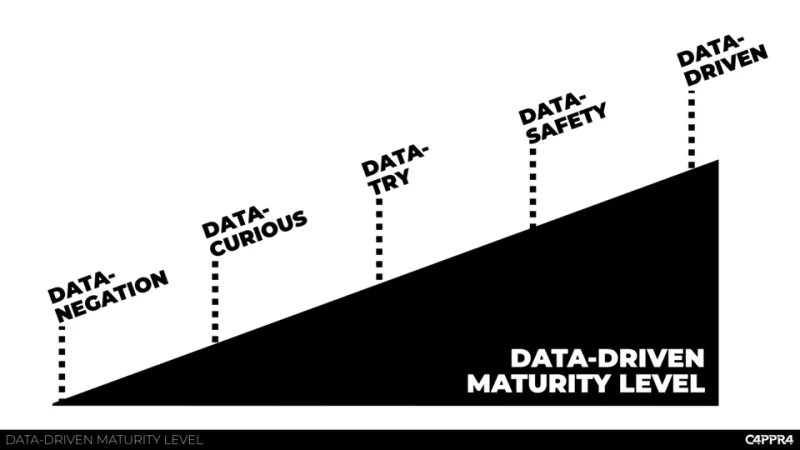
Photo: Cappra.cc, CC BY-SA 4.0, via Wikimedia Commons
Ask any enterprise executive whether their organization is data-driven, and the answer is almost always yes. Ask them what that means in practice, and the answers diverge sharply. Some describe robust reporting infrastructure and weekly performance reviews. Others point to machine learning pilots or predictive models deployed in specific business units. A smaller group describes something more ambitious: analytics systems that do not simply inform decisions but actively recommend them, continuously, at scale.
These are not variations on the same capability. They represent fundamentally different stages of analytical maturity—stages that carry different strategic implications and require different organizational investments to advance through. Understanding where your enterprise actually sits on this continuum, and what it genuinely takes to move forward, is one of the most consequential questions in modern business leadership.
Stage One: Descriptive Analytics—Knowing What Happened
Every analytics journey begins with description. At this foundational stage, the enterprise has built the infrastructure to capture operational data and report on it in standardized formats. Revenue reports, headcount summaries, website traffic metrics, inventory levels—the organization can look backward with reasonable accuracy and answer the question: What happened?
This is not a trivial achievement. Many organizations that believe they have moved beyond this stage are, in practice, still operating primarily within it. The defining characteristic of Stage One is not the absence of data or technology—it is the absence of integration and timeliness. Reports are produced on fixed cycles, often weekly or monthly. Data lives in departmental systems that do not communicate with one another. Analytical work is largely retrospective, and the primary consumer of insights is the finance or operations function.
The strategic limitation here is clear: by the time a descriptive report reaches a decision-maker, the moment it describes has already passed. Organizations at this stage are, in effect, navigating by looking through the rearview mirror.
Stage Two: Diagnostic Analytics—Understanding Why It Happened
The move from description to diagnosis represents the first meaningful leap in analytical sophistication. At Stage Two, the enterprise is no longer satisfied with knowing that revenue declined in Q3. It wants to understand why—and it has the analytical tools and data connectivity to investigate.
Diagnostic analytics requires cross-functional data integration. Understanding why a customer retention metric dropped demands access to sales data, customer service records, product usage logs, and potentially supply chain performance data simultaneously. This is where many organizations encounter their first serious structural barrier: the departmental silos that made Stage One manageable become significant obstacles at Stage Two.
Organizations that successfully navigate this transition typically do so by investing in data warehousing or modern data platform infrastructure that allows analysts to query across functional datasets. They also begin developing analytical talent that can move between domains—analysts who understand both the technical mechanics of data querying and the business context required to interpret what they find.
The strategic value at this stage is real but still limited. Diagnosis is inherently retrospective. The organization is becoming better at understanding past performance, but it is not yet positioned to anticipate or influence future outcomes.
Stage Three: Predictive Analytics—Anticipating What Will Happen
Predictive analytics is where the competitive stakes rise substantially—and where the gap between organizations that have genuinely reached this stage and those that believe they have becomes most consequential.
At Stage Three, the enterprise is deploying statistical models and machine learning algorithms to generate probability-weighted forecasts about future outcomes. Customer churn models that score individual accounts by likelihood of attrition. Demand forecasting systems that adjust inventory recommendations based on seasonal patterns, economic indicators, and promotional calendars. Credit risk models that evaluate lending exposure in real time. These are not hypothetical applications; they are operational realities in the most analytically mature US enterprises across financial services, retail, healthcare, and logistics.
The organizational requirements for genuine predictive capability are demanding. Data quality must be high and consistent—predictive models are only as reliable as the historical data they are trained on. Data science talent is scarce and expensive. And perhaps most importantly, business leaders must be willing to trust and act on probabilistic outputs rather than waiting for certainty that will never arrive.
This last requirement is where many organizations stall. The technical infrastructure for prediction may exist, but the organizational culture has not evolved to embrace uncertainty as an input to decision-making. Leaders who grew up in descriptor-and-report environments often find it deeply uncomfortable to authorize significant resource allocation based on a model's confidence interval rather than a confirmed historical fact.
Stage Four: Prescriptive Analytics—Being Told What to Do About It
The final stage of the maturity framework is the one that most organizations discuss but few have reached. Prescriptive analytics does not merely predict what will happen—it recommends specific actions to optimize outcomes, often in real time, and sometimes executes those recommendations autonomously.
Consider a large US retailer whose pricing engine continuously adjusts thousands of product prices based on competitor activity, inventory levels, demand signals, and margin targets—without human intervention. Or a logistics company whose routing optimization system recalculates delivery schedules in response to weather events, traffic patterns, and driver availability simultaneously. These are prescriptive systems: they absorb data, model outcomes, and recommend or execute decisions at a speed and scale no human analyst could match.
The organizational transformation required to reach Stage Four extends well beyond technology. It demands a fundamental renegotiation of the relationship between human judgment and algorithmic recommendation. Leaders must define which decisions can be delegated to automated systems, which require human review of algorithmic recommendations, and which should remain entirely within human discretion. This is not a technical question—it is a governance and leadership question, and getting it wrong carries significant operational and reputational risk.
It also requires what might be called an analytics-native culture: an organization where every function understands how to interpret, challenge, and act on analytical outputs. Training and change management investments at this stage often exceed the technology investments themselves.
Where Most Enterprises Actually Are
Honest self-assessment reveals that the majority of large US enterprises are operating primarily between Stages Two and Three. They have moved beyond basic reporting, they have some diagnostic capability, and they may have deployed predictive models in one or two high-priority domains. But they have not yet achieved the breadth, integration, or organizational alignment required to make prescriptive analytics a consistent operational reality.
The most common sticking point is the transition from Stage Three to Stage Four. Predictive models exist but are not connected to decision workflows. Recommendations are generated but not acted upon systematically. The analytics function produces insights that leadership finds interesting but does not consistently translate into changed behavior.
Advancing through this barrier requires treating analytics as an enterprise capability rather than a departmental one—embedding intelligence into the processes and systems where decisions are actually made, rather than producing reports that compete for attention in an already crowded leadership agenda.
The View from the Top
The enterprises that reach and sustain Stage Four share a common characteristic: they have stopped thinking of analytics as a reporting function and started treating it as a decision-making infrastructure. Their data strategy is inseparable from their business strategy. Their analytical capabilities are not housed in a single center of excellence—they are distributed across the organization, governed centrally, and connected to a unified intelligence layer that ensures every function is working from the same version of reality.
The distance between where most enterprises are and where the most advanced ones operate is not primarily a technology gap. It is a leadership and organizational design gap. Closing it requires clarity about where you are, honesty about what is holding you back, and the organizational will to make the investments—technical and human—that genuine analytical maturity demands.